London market commentary
London is a leading global city, with a strong reputation in finance, tourism, entertainment and the arts.
Arguably, its most important role is that of an economic and financial
centre, with London generating 20% of the UK's GDP, which is the
largest GDP of any European city.
More than half of the UK's FTSE 100 leading companies and more than
100 of Europe's 500 largest companies are headquartered in central
London.
London is also very well known as a tourist destination. Tourism is a
vital contributor to London's economy and is one of London's largest
industries accounting for 10% of London's GDP. Tourism is responsible
for 235,000 jobs in the capital.
London has five international airports, including Heathrow, the world's
busiest airport by passenger numbers. London is also supported by a
strong public transport network, with the London Underground being
one of the largest underground networks in the world.
One of the key areas of growth over the last decade in London has
been education. London has 40 higher education institutions, including
some of the oldest and most world famous colleges, such as King's,
Imperial and the London School of Economics. There is a student
population of over 400,000, with a significant proportion of them
coming from overseas.
London's population as a whole was calculated at 7.56m in 2007, with
an increase of approximately 500,000 in the last decade.
The Greater London Authority has made population growth forecasts
to 2031, with a summary map indicating the main areas of population
growth set out below.
With the continued support of big business and strong tourism and
education industries, London is set to continue to be one of the
world's great cities, with investment property and infrastructure being
a core activity for the foreseeable future.
Population growth forecasts 2011 - 2031
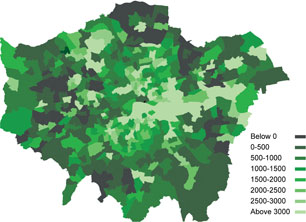
Source: CB Richard Ellis / GLA